
Tooth extractions in Hollywood, FL
When a tooth can’t be saved, how it comes out matters — and so does what goes in its place. Dr. Tamara Rojas, a board-certified periodontist, numbs you thoroughly, offers sedation, and plans the replacement before the extraction so you aren’t left with a gap or lost bone.
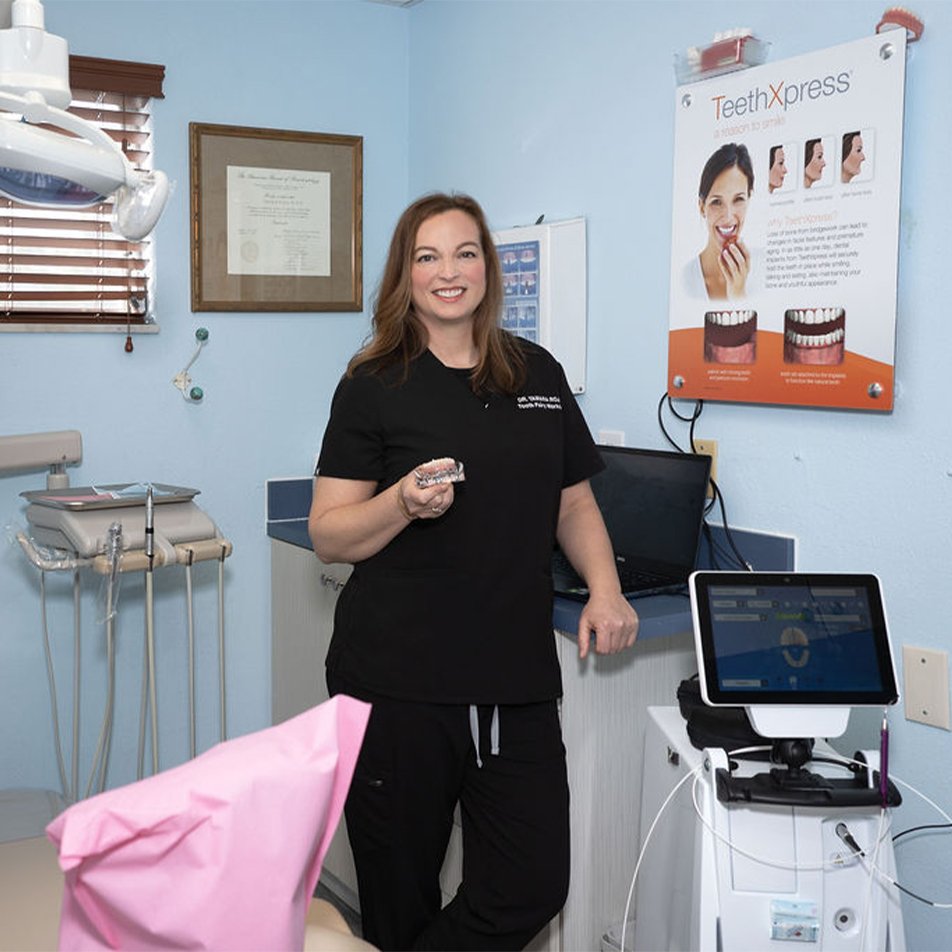 Numb and comfortable first
Special offers from a board-certified periodontist and implant specialist
Implant Package
Bone Graft at the time of extraction (D7953)
Ridge augmentation (D7950), CBCT (D0364)
Implant (D6010), Abutment (D6057), Crown (D6058)
Common reasons a tooth needs to be removed.
Dentists usually try to save a tooth first. Cleveland Clinic lists these as the most common reasons an extraction becomes the better choice.
Source: Cleveland Clinic — Tooth Extraction. Bleeding or loose teeth? Gum disease can often be treated before it costs a tooth — see periodontal therapy.
Simple, surgical or wisdom tooth?
Sources: MedlinePlus — Tooth extraction; Cleveland Clinic — Wisdom Teeth Removal. More complex cases are part of our oral surgery care.

An extraction is step one, not the end.
Dr. Rojas confirms whether the tooth can be saved and explains why it can’t if extraction is the answer.
A dental implant, a bridge or a partial denture. Knowing the plan now lets us prepare the site properly.
If an implant is planned, a bone graft can be placed in the socket at the same visit to help prevent bone loss.
Post-operative visits are included in the cost of the extraction, and if a problem comes up we keep treating it at no additional charge.

I’ve heard plenty of extraction horror stories, and most of them come down to rushing. I take the extra time to make sure you are completely numb before I start, and I would rather pause than push through.
Whatever the reason a tooth has to go, I want us to talk about what replaces it before the day of the extraction. That one conversation can save you bone, time and a second surgery.
Dr. Tamara Rojas, D.M.D. · Board-Certified Periodontist · Read her background
The first few days after an extraction.
Follow the written instructions we give you — they are tailored to your procedure. In general, Cleveland Clinic advises folding gauze over the site and biting down gently for 15 minutes, repeating as needed; some oozing the first night is normal. Use an ice pack on your face, 20 minutes on and 20 minutes off, to limit swelling. Eat soft foods, brush your other teeth normally, and skip strenuous exercise and heavy lifting for 48 to 72 hours. (Cleveland Clinic: Tooth Extraction)
Protect the blood clot. MedlinePlus advises no straws for at least 24 hours, no smoking or tobacco while you heal, and waiting about three days before rinsing with salt water. Suction and smoking can pull the clot out of the socket. (MedlinePlus: Tooth extraction)
That lost clot is what causes dry socket. Cleveland Clinic notes it affects about 2% to 5% of extractions, is more common after wisdom teeth, and usually shows up within the first three days as pain that spreads from the jaw toward the head or neck, a bad taste, or a socket that looks empty. Call us if that happens: the ADA’s MouthHealthy explains that your dentist can clean the socket and place a medicated dressing to ease the pain while it heals. (Cleveland Clinic: Dry Socket; MouthHealthy: Dry Socket)
Also call (954) 963-4700 for bleeding that won’t stop, a fever, pus at the site, or pain that medication doesn’t help. If you are in pain after hours, see our dental emergency guidance.
Dry socket is uncommon — and treatable.
Source: Cleveland Clinic — Dry Socket.
of tooth extractions develop dry socket
the window when it usually appears
Nervous about having a tooth out?
“Got a tooth extracted today. I was nervous about it all day. I went to my appointment and felt right at home. Very friendly staff…”
Tooth extraction questions
Will I feel the extraction?+
The area is numbed with local anesthetic before we start, and we make sure you are fully numb first. Most patients feel pressure rather than pain. If you’re anxious, you can add nitrous oxide, oral sedation or IV sedation.
Do I need to replace a pulled tooth?+
Usually, yes — especially back teeth that you chew with. Options include a dental implant, a bridge or a partial denture. Planning the replacement before the extraction lets us place a bone graft in the socket if an implant is the goal.
Can I get an implant right after an extraction?+
It depends on the tooth and the bone around it. Often the socket is grafted and allowed to heal for a few months first; Dr. Rojas will tell you which approach fits your case at your consultation.
How long does it take to heal after a tooth is pulled?+
Most people are back to routine activities within two to three days, and bruising and swelling fade within about a week. The bone underneath takes longer — several weeks, and up to four months for a large tooth such as a molar.
How do I avoid dry socket?+
Protect the blood clot: don’t use straws, don’t smoke or vape, avoid vigorous rinsing and spitting, and stick to soft foods. If pain gets worse after the first few days instead of better, call us.
Do all wisdom teeth need to come out?+
No. Wisdom teeth are usually removed when they are impacted, cause pain, trap food, decay, or damage nearby teeth — or when an exam shows they are likely to. We’ll look at your x-rays and tell you whether yours need attention.
A tooth that has to go? Plan what comes next.
Book an extraction consultation with board-certified periodontist Dr. Tamara Rojas in Hollywood, FL. Missing several teeth? Ask about TeethXpress®.
From Dr. Rojas’ blog
Why Do We Need Wisdom Teeth when They Get Removed so Often?
Curious about wisdom teeth? Dr. Tamara Rojas explains why we have them and when extraction is necessary. Oral surgery in Hollywood, FL.…
Read the article →ArticleHow Dental Implants Work and Why They’re a Game Changer
How do dental implants work? Hollywood periodontist Dr. Tamara Rojas explains the parts of an implant, each step from consult to final…
Read the article →ServicesAll periodontal & implant services
Gum disease treatment, LANAP, dental implants, extractions, sedation and general dentistry in one place.
See all services →